 how-to
Grief Counselling vs Support Groups: Which Helps?
Table of Contents
- Grief Counselling vs Grief Support Groups: How the Two Compare
- Individual Grief Counselling: What One-to-One Support Offers
- The Benefits of Grief Support Groups
- What to Expect at a Grief Support Group
- Group Grief Counselling: Structured Programs with Professional Guidance
- How to Choose the Right Grief Support for You
- Other Grief Support Options: Helplines, Online Forums and Peer Networks
- Frequently Asked Questions
Last Updated: October 9, 2026
Grief Counselling vs Grief Support Groups: How the Two Compare
Grief counselling is one-to-one professional support with a qualified practitioner, while a grief support group brings bereaved people together to share experiences under light facilitation.

Grief is not a problem to be solved. It is a process to be supported, and the support you choose shapes how that process unfolds. Some people need privacy and depth.
Below, we compare grief counselling vs grief support groups across cost, structure, and what actually happens in the room. We will also cover how to combine both, and when a helpline or online forum is a better first step.
| Feature | Individual Grief Counselling | Grief Support Group |
|---|---|---|
| Format | One-to-one with a counsellor | Small group, 6-12 people |
| Focus | Your personal loss story | Shared experiences |
| Cost | Varies; some free services exist | Usually free or low cost |
| Waiting time | Varies by service | Varies by service |
| Best for | Complex or private grief | Isolation and loneliness |
| Led by | Qualified counsellor | Facilitator or peer |
Individual Grief Counselling: What One-to-One Support Offers
Individual grief counselling is private, booked support with a qualified counsellor who focuses entirely on your loss. Sessions typically run for around an hour, and you set the pace. Nothing is shared with anyone else, which matters if you are not ready to speak in front of others.
What one-to-one support does well:
- Gives you space to say the unsayable without an audience
- Works through complicated feelings, including anger, guilt, and relief
- Fits around chronic illness, disability, or irregular energy levels
- Builds a steady relationship with one trusted person
A common mistake is waiting until things feel "bad enough" to book. Grief does not follow a schedule.
What to Expect at a First Counselling Session
A first counselling session is usually a gentle getting-to-know-you conversation, not an interrogation. Your counsellor will ask what brought you there, who you lost, and what you are hoping for. You are not required to tell your whole story in one sitting.
You might feel drained afterwards. That is normal. Many people find the first session is mostly about deciding whether this person feels safe.
If you have tried counselling before and it did not stick, that is worth saying out loud in the first session. Fit matters more than method.
The Benefits of Grief Support Groups
The main benefit of grief support groups is simple: they remove the isolation. Sitting with people who have also lost someone changes how grief feels. You stop performing "I'm fine" and start speaking plainly.
But the benefits go further than company, and understanding the mechanism helps you judge whether a group will actually suit you.
Why shared experience works differently to professional support
A counsellor can empathise, but they are not bereaved in that moment. In a group, the person across from you has lived the thing you are living.
Other benefits of grief support groups include:
- Normalising the timeline. Grief rarely follows the neat stages people expect. Hearing someone two years in still having hard days can be more reassuring than any explanation.
- Practical coping mechanisms. Not theory, what actually got someone through the first birthday, the first Christmas, the empty chair at dinner.
- Reciprocity. Feeling useful when your experience helps someone else is one of the few reliable lifts in early grief.
- Low barrier to entry. Many community groups accept self-referral, so you can often attend without a GP referral or a waitlist.
- Ongoing contact. Some groups continue informally between sessions, which matters if your usual support network has drifted.
What groups do not do
What most guides miss is that groups are not therapy. They are community. A group cannot give you the sustained, individual attention that complex or traumatic grief often needs, and it is not designed to.
Groups also carry specific risks worth naming:
- Comparison. Hearing someone whose loss seems "worse" can make your own feel illegitimate. Good facilitators name this early.
- Emotional contagion. A heavy session can leave you flatter than you arrived. That is normal, but it is worth planning a decompression walk or a call afterwards.
- Fixed pace. The group moves at the group's speed, not yours. If your loss is very recent, that mismatch can feel jarring.
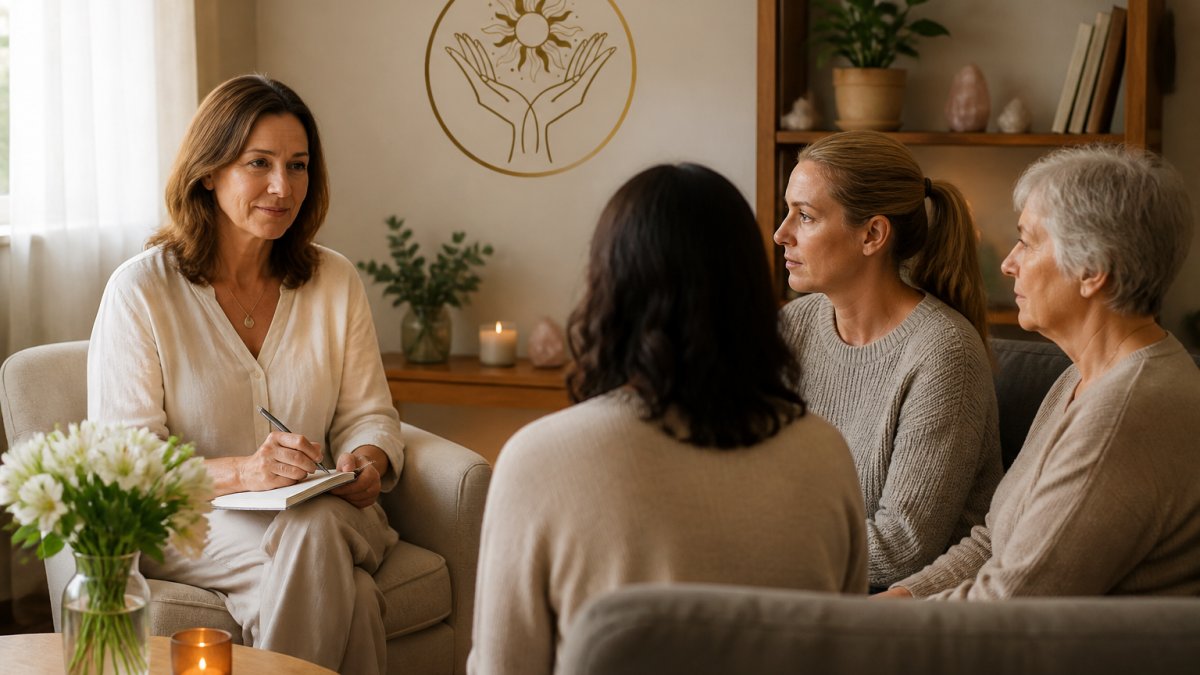
What to Expect at a Grief Support Group
At a grief support group, you can expect a facilitated conversation among a small number of bereaved people, usually lasting 60 to 90 minutes. Most groups open with a check-in, move into a theme or open sharing, and close with a grounding moment. (Source: mental health professionals)
What to expect at a grief support group varies by format:
- Open groups let you attend when you can, with different faces each time
- Closed groups run for a set number of weeks with the same members
- Peer-led groups are run by bereaved volunteers, not professionals
- Professionally facilitated groups have a counsellor present
You can usually just listen at first. Most facilitators will not push you to speak, and many people attend several sessions before saying a word.
Group Grief Counselling: Structured Programs with Professional Guidance
Group grief counselling sits between the two: it is a structured program led by a qualified professional, run with a small group over a set number of weeks. Unlike an open peer group, the content is planned, and the facilitator guides the emotional work.
This format suits people who want professional support but also want to feel less alone. You get the expertise of a counsellor and the shared experience of a group in one room.
Where it falls short: you cannot go as deep into your own story as you would in individual sessions, and the group's pace may not match yours. If your loss is very recent or very raw, one-to-one support first is often the kinder path.
How to Choose the Right Grief Support for You
Choosing the right grief support comes down to a small number of honest questions. Most people answer them in under a minute, and the decision usually makes itself.
A short decision guide
Work through these in order. Stop at the first one that describes you.
- Is your grief tangled, traumatic, or tied to a difficult relationship with the person you lost? If yes, start with individual counselling. Groups are not built to hold complexity at that depth.
- Is your main pain loneliness, the sense that nobody in your life understands? If yes, a support group is often the faster relief. You can be in a room with people who get it this week, not in six.
- Do you want professional guidance but also want to feel less alone? Group grief counselling, a structured, professionally facilitated program, sits between the two.
- Can you not face a booking yet, but need to talk tonight? Start with a helpline. It is not a lesser option; for many people it is the first place they say the words out loud.
- Are you unsure whether you are "bad enough" to need help? You are not required to qualify.
The access questions nobody explains clearly
Before you commit to anything, it helps to know what you are walking into. Availability varies widely by region and service, so treat the following as the questions to ask rather than fixed answers.
- Referral. Some counselling services accept self-referral; others need a GP referral or a mental health care plan. Ask before you book, because this is the most common reason people stall.
- Cost. Community and hospital-based bereavement services are often free or low cost. Private practitioners set their own fees, and some offer a sliding scale, it is reasonable to ask.
- Wait times. Publicly funded counselling can carry a waitlist; peer-led groups often have none. If you need support now, that difference matters more than the format.
- Format. In-person, telephone, and video options all exist. If travel, disability, chronic illness, or caring responsibilities make attending hard, ask specifically about distance sessions.
- Facilitation. Ask whether a group is peer-led or professionally facilitated. Neither is automatically better, but they offer different things, and you should know which you are choosing.
A simple way to test fit
You do not have to commit forever. Try one session or one meeting and ask yourself three things afterwards: Did I feel safe? Did I feel heard? Would I go back?
Other Grief Support Options: Helplines, Online Forums and Peer Networks
Helplines, online forums, and peer networks fill the gaps when counselling waitlists are long or when you need support at an awkward hour. They are not a lesser option. For many bereaved people, a telephone support line is the first place they say the words out loud.
Your options include:
- National helplines offering free telephone support and, in some cases, booked support calls
- Online forums and community forums where bereaved individuals write to each other at any hour
- Peer support networks connecting you with someone who has had a similar loss
- Creative therapies such as art therapy and music therapy, which can help when talking feels impossible
Online spaces suit people who want privacy or who live far from local services. The trade-off is that forums are unmoderated in places, and reading other people's rawest moments can be heavy. If a thread leaves you feeling worse, step away.
If you are in crisis or having thoughts of harming yourself, contact emergency services or a crisis line immediately rather than waiting for a group or appointment.
Frequently Asked Questions
What is the difference between grief counselling and a grief support group?
Grief counselling is one-to-one professional support, usually with a qualified counsellor or therapist, where you talk privately about your loss. A grief support group brings together several bereaved people to share experiences, often facilitated by a trained peer or professional. Counselling offers tailored, private guidance; groups offer connection and shared understanding. Many people use both at different times, depending on what feels right.
Can I attend grief counselling and a support group at the same time?
Yes, combining both is common and often helpful. Individual grief counselling gives you space to process personal emotions, while a support group reduces isolation through shared experiences. The two can complement each other. It's worth telling both your counsellor and group facilitator so they can support you together, and to check you're not taking on too much at once.
How do I know if I need grief counselling?
If your grief feels overwhelming, lasts a long time without easing, affects your daily life, sleep or relationships, or if you feel stuck, talking to a professional can help. There's no threshold you must reach. Some people seek counselling soon after a loss; others months later. If you're unsure, start with a conversation with your GP or a helpline, and consider what kind of support feels manageable.
What should I look for when choosing a grief support group?
Look for a group that feels safe and welcoming, with clear ground rules about confidentiality and respect. Check whether it's peer-led or professionally facilitated, and whether it's specific to your type of loss (for example, loss of a parent, partner or child). Ask about group size, meeting frequency and whether you can visit before committing. Trust your comfort level, and remember you can try another group if it doesn't feel right.
Grief does not need to be rushed, and it does not need to be carried alone. If you are looking for gentle, trauma-informed support that honours where you actually are, The Vitality Seeker offers one-to-one grief coaching, Reiki and crystal healing, and the nine-week Beyond the Layers program, all built around nervous-system safety and care rather than pressure to change. Book a treatment with The Vitality Seeker and take the next step at your own pace.